Cart is empty


Some words on a food label are backed by a federal rule with numbers in it. Others have no legal definition at all. "Organic" and "gluten-free" are in the first group. "Artisan" and "local" are in the second.
Knowing which is which changes how you shop. Below are seven terms common on jars from farm markets and small kitchens, what each one legally means (or does not), and real labels from LocalCart’s makers to practice on.
Food label terms decoded
Four are defined by rule, three rest on trust
These food label terms run roughly from the loosest to the most tightly defined. A good place to practice is the preserves aisle, where LocalCart lists artisanal food such as farm-market jams, jellies, pickled eggs and molasses.
- 1Artisan or artisanalBest for a question, not a guarantee
- 2Natural or all naturalBest for spotting added colors
- 3Local or locally madeBest for asking "how far?"
- 4OrganicBest for shoppers who want certified
- 5Jam, jelly & preservesBest for breakfast shoppers
- 6Gluten-freeBest for celiac households
- 7Made in USABest for origin-minded buyers
1. Artisan or artisanal
No US agency defines it
So what does artisanal mean on a US label? Legally, nothing specific. Neither FDA nor USDA defines artisan food, so the word tells you how the maker sees the product, not a standard it met.
For a working definition, borrow one from abroad. Ireland’s food safety authority issued non-binding guidance in 2015 saying "artisan" should only be used when all of these hold:
- The food is made in limited quantities by skilled craftspeople
- The process is not fully mechanized and follows a traditional method
- It is made in a micro-enterprise at a single location
- The characteristic ingredients are grown or produced locally, where seasonal and practical
2. Natural or all natural
An FDA policy, not a rule
FDA has long read "natural" to mean that nothing artificial or synthetic, including any color additive regardless of source, was added that you would not normally expect. The agency says it has not made a formal definition, and that the policy does not address pesticides or processing methods such as pasteurization.
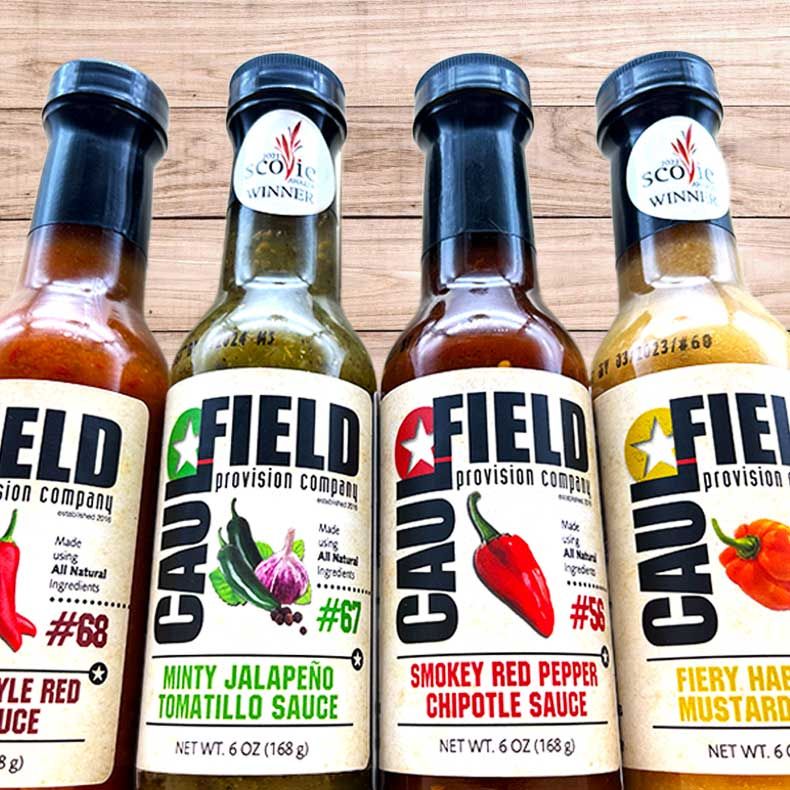
Caulfield Provision Company’s sauce labels read "Made using All Natural Ingredients." That is a claim about what went into the bottle, and nothing more.
3. Local or locally made
A distance with no legal radius
The 2008 Farm Bill defined local food as under 400 miles from origin or within the same state, as the National Agricultural Library lays out, but no federal rule applies that definition to the word on a jar.
State programs fill part of the gap. Virginia’s Finest, run by the state agriculture department since 1989, says only Virginia products that meet or exceed its quality standards are eligible. A state logo at least tells you the state, which the word local alone does not.
4. Organic
Three tiers & a $5,000 exception
Organic is one of the most tightly defined words here. Under 7 CFR 205.301, "100 percent organic" means what it says, "organic" needs at least 95 percent organic ingredients, and "made with organic" needs at least 70 percent. Below that, organic can appear only in the ingredient list.
Very small producers get an exemption. An operation with $5,000 or less a year in organic sales can sell its food as organic without certification, but it may not use the USDA seal or call itself certified. Seal on the jar, certified. Organic with no seal, ask.
5. Jam, jelly & preserves
Federal standards with fruit-to-sugar ratios
Jam and preserves share one federal standard. For fruits such as strawberry, blackberry, grape and huckleberry, the recipe needs at least 47 parts fruit to 55 parts sugar, and the finished jam or preserve reaches 65 percent soluble solids. Jelly has its own standard, made from fruit juice, at 45 parts juice to 55 parts sugar.
Loudounberry’s Muscadine Jam is a handy test. Its jar reads Muscadine Jelly and lists muscadine juice, not crushed fruit, so by the federal definitions it sits with jelly. When a name and an ingredient list point different ways, the ingredient list tells you what is in the jar.

6. Gluten-free
Under 20 parts per million, by rule
FDA’s gluten-free rule lets a food carry the claim only if it has no gluten-containing grain as an ingredient (unless it was processed to remove gluten) and contains less than 20 parts per million. The claim is voluntary, and the maker is responsible for meeting it.
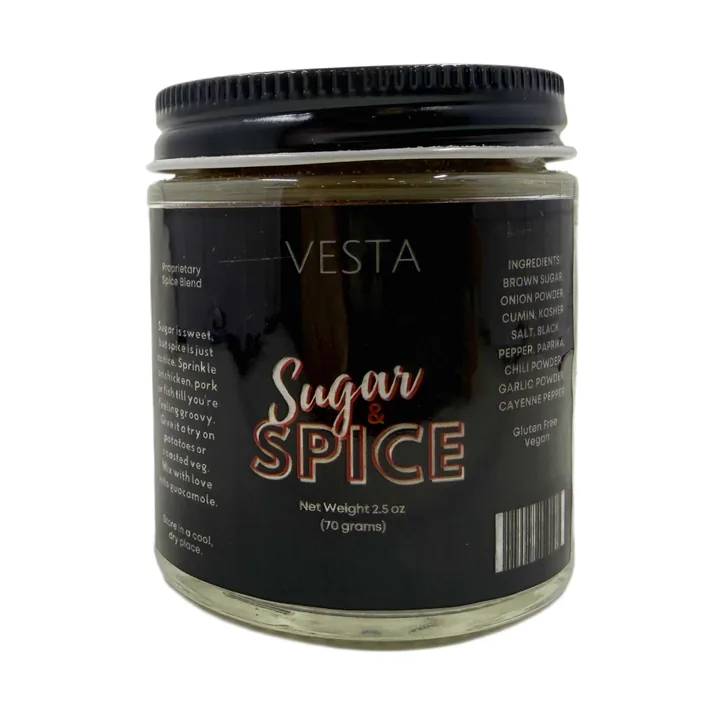
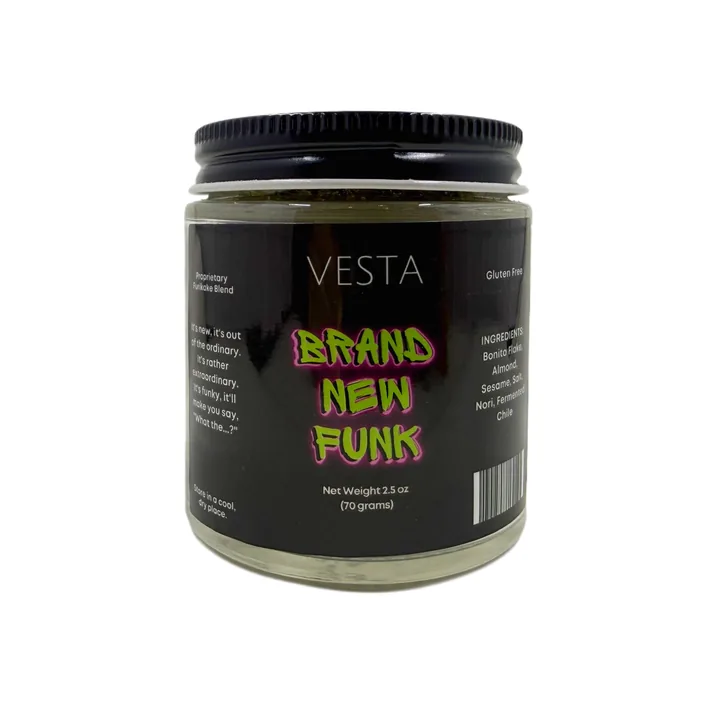
Vesta Kitchen’s Sugar & Spice blend reads "Gluten Free, Vegan," and its Brand New Funk furikake also says "Gluten Free." LocalCart does not test products, so the label is the maker’s own statement.

7. Made in USA
All or virtually all, says the FTC
An unqualified Made in USA claim means final processing happens in the US and "all or virtually all ingredients or components" are made and sourced here, the FTC explains. Its labeling rule, finalized in 2021, puts that standard on labels.
Lahtt’s chili oil jar carries a Made in USA badge. Floral Elixir describes its flower syrups as handmade in the USA in small batches, which pairs an origin claim (covered) with a method claim (not covered).


Reading local market food labels
Six lines matter more than any adjective
Packaged food labels follow the same federal basics whether the jar comes from a national brand or a farm stand. Local market food is no exception, though very small makers can skip the Nutrition Facts panel.
| Label line | What it tells you | Rule |
|---|---|---|
| Product name | What the food legally is, on the front panel | 21 CFR 101.3 |
| Ingredients | Everything in it, heaviest first by weight | 21 CFR 101.4 |
| Allergens | Any of the nine major allergens, in a list or "Contains" line | FDA allergen rules |
| Net weight | How much food, not counting the jar | Federal and state rules |
| Maker & address | Who stands behind it | 21 CFR 101.5 |
| Nutrition Facts | Required unless a small-business exemption applies | 21 CFR 101.9 |
Ingredients run in descending order of predominance by weight, so the first word is the main one. FDA counts nine major allergens, with sesame added on January 1, 2023, and they must be named in the ingredients or a "Contains" statement. Brand New Funk lists bonito, sesame and almond, so it carries fish, sesame and a tree nut.
Nutrition Facts are where small makers differ. FDA exempts a product from a business averaging fewer than 100 full-time equivalent employees that sells fewer than 100,000 units of it a year in the US, sometimes with a notice to the agency, unless the label makes a nutrition claim. Very small sellers to consumers have a separate exemption.
To practice, open any listing in the LocalCart catalog of makers and zoom in on the label photo. The page about LocalCart presents it as a way to find small producers. Its Terms add that it "does not pre-screen users," so the label is the maker’s promise.
Small batch meaning & craft food claims
Useful words with no legal size attached
There is no federal small batch meaning. A batch can be ten jars or ten thousand, and craft food is a mood, not a category. The useful move is to ask for the number.
Some makers give it unprompted. Floral Elixir says it still makes each bottle by hand from 10-gallon batches, and Pasta Lab says it began with home sourdough baking and a tabletop grain mill. Details like these are what LocalCart’s guide on how to find local artisans tells you to look for.
Handmade, homemade & hand-packed
Three words, three different claims
None of these three has a federal food definition. Handmade food describes how it was made, hand-packed describes only how it went into the jar, and homemade often hints at a home kitchen, which is where state cottage food law takes over.
Questions to ask a small maker0 of 4 done
What a cottage food label must say
Home-kitchen foods carry a warning, & it varies by state
Cottage food laws let people sell certain low-risk foods made at home. Each state writes its own, and the cottage food label is where the differences show.
| State | Program | What the label adds |
|---|---|---|
| Maryland | Cottage food business | "Made by a cottage food business that is not subject to Maryland’s food safety regulations." |
| Virginia | Home food processing exemption | "NOT FOR RESALE" plus "PROCESSED AND PREPARED WITHOUT STATE INSPECTION," with date made |
| Pennsylvania | Limited Food Establishment | No extra statement on the state page, the home kitchen is registered and inspected instead |
Maryland’s statute also requires the name and address (or phone and an ID number), the product name, ingredients by weight, net weight and allergen information, with that statement in 10-point type or larger. Products sold in a retail store add a phone number, email and the date made.
Virginia’s exemption, per the VDACS July 2026 FAQ, requires the preparer’s name, address, phone and processing date on the front panel, plus the standard label lines. Sales by phone or internet are allowed, but only to buyers within Virginia, never across state lines. Pennsylvania takes a different route. Its Limited Food Establishment registration involves routine inspection of a home kitchen making shelf-stable, non-potentially hazardous foods such as jams, jellies, candies and baked goods without cream fillings. Labels there need the product name, ingredients by weight, net weight or volume, business name and address, and any allergens.
Allergen and ingredient lines still follow FDA food labeling rules. Rules change, so check your state agriculture or health department before buying or selling.
Sources
- Food Safety Authority of Ireland, Guidance Note 29, The Use of Food Marketing Terms, 2015
- FDA, Use of the term natural on food labeling
- USDA National Agricultural Library, What makes a food local
- Virginia Department of Agriculture and Consumer Services, Virginia’s Finest
- 7 CFR 205.301, Product composition (organic labeling)
- 7 CFR 205.101, Exemptions from certification
- 7 CFR 205.310, Products of an exempt operation
- 21 CFR 150.160, Fruit preserves and jams
- 21 CFR 150.140, Fruit jelly
- 21 CFR 101.91, Gluten-free labeling of food
- FTC, Complying with the Made in USA Standard
- 21 CFR 101.4, Designation of ingredients
- FDA, Food allergies
- 21 CFR 101.9, Nutrition labeling of food
- Maryland Health-General 21-330.1, Cottage food businesses
- VDACS, Virginia’s Home Food Processing Exemptions FAQ, July 2026
- Pennsylvania Department of Agriculture, Limited Food Establishment
- FDA, Food labeling and nutrition
Artisanal food FAQs
Frequently asked questions
What does the term artisan mean on food?
In the US it has no legal meaning, so it reflects the maker’s own view. Ireland’s 2015 guidance is a good yardstick: limited quantities, skilled makers, a traditional and not fully mechanized method, one small site.
Is "natural" regulated on food labels?
Only loosely. FDA treats it as meaning nothing artificial or synthetic was added, including color additives, but it has no formal definition and it says nothing about pesticides or processing.
What is the difference between jam and jelly?
Jam and preserves are made from the fruit itself, and jelly from fruit juice. FDA sets separate standards of identity for each, both at 65 percent soluble solids.
Does small batch mean better quality?
Not by definition. Small batch has no legal size, so ask how large a batch is and who makes it.
Do cottage food labels have to list allergens?
In Maryland, yes, as federal labeling rules specify. Other states set their own lists, so check the state agency that runs the program.
Local food & small-batch shopping guides
More from the LocalCart blog