Cart is empty


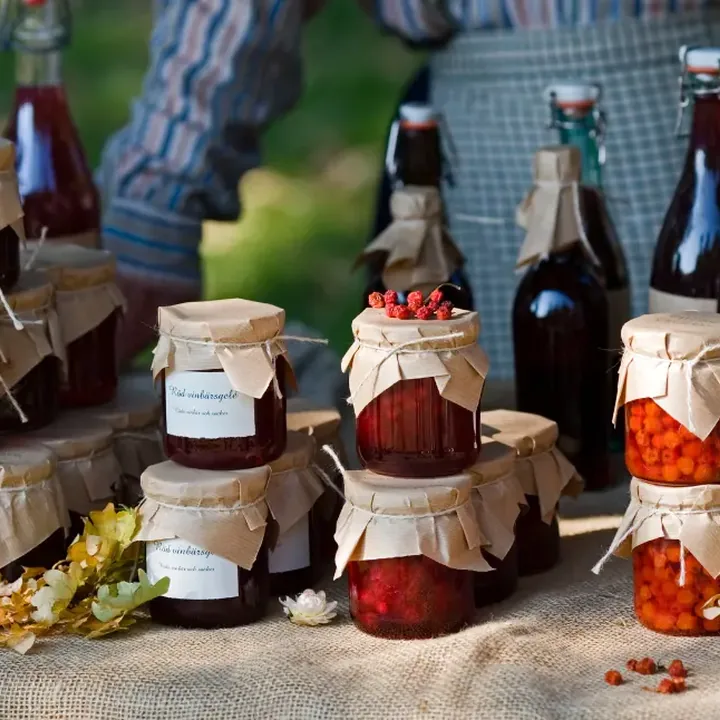
Jelly is made from fruit juice that has been strained clear, then set with sugar and pectin. Jam and preserves are made from the fruit itself: crushed or chopped for jam, whole small fruit or uniform pieces for preserves.
That split is the whole story in a home kitchen. On a store shelf there is a second layer, because the FDA keeps a standard of identity for preserves and jams and another for fruit jelly. Those rules decide how much fruit has to go in the jar before it can carry the name.
Difference between jam & jelly
Juice makes jelly. Fruit makes jam & preserves.
Short answer
Jelly is strained juice. Jam is crushed fruit. Preserves keep the fruit whole or in pieces.
Under federal rules, jam and preserves are one standard with two allowed names. Jelly has its own standard.
- Jelly: clear, firm, holds a clean edge when you cut it
- Jam: thick and spreadable, fruit cooked down until the shape is gone
- Preserves: plump whole berries or chunks in a softly set syrup
Jelly
Fruit juice, sugar, pectin, acid
Jam
Crushed or chopped fruit, sugar
Preserves
Whole small fruit or uniform pieces
The National Center for Home Food Preservation (NCHFP) gives the working definitions. Jellies are usually made by cooking fruit juice with sugar, and a good one is "clear and firm enough to hold its shape when turned out of the container, but quivers when the container is moved." Jams are "thick, sweet spreads made by cooking crushed or chopped fruits with sugar." Preserves are "small, whole fruit or uniform size pieces in a clear, slightly gelled syrup."
So the jam vs jelly question comes down to one step: whether the cook strained out the pulp. The preserves vs jelly gap is wider still, since preserves keep the most fruit structure of the three and jelly keeps none.
What the FDA standards say
The law sees two foods, not three
The federal standard at 21 CFR 150.160 is titled "Fruit preserves and jams," and it says the name of the food "is “Preserve” or “Jam”." Same fruit list, same ratios, same sugar test. In legal terms, jam vs preserves is a naming choice, and the difference you taste comes from how the maker cuts and cooks the fruit. LocalCart files the whole jam vs preserves family on one Preserves shelf, where Loudounberry's jams sit next to its jellies.
| Feature | Jam | Preserves | Jelly |
|---|---|---|---|
| Starts from | Crushed or chopped fruit | Whole small fruit or uniform pieces | Filtered or strained fruit juice |
| Federal standard | 21 CFR 150.160 | 21 CFR 150.160 (same section) | 21 CFR 150.140 |
| Minimum fruit to sweetener | 47 parts fruit per 55 parts sweetener for Group I fruits such as berries, 45 for the rest | Same as jam | 45 parts juice per 55 parts sweetener |
| Soluble solids (mostly sugar) | At least 65% | At least 65% | At least 65% |
| Texture | Holds its shape, softer than jelly | Tender fruit in a slightly gelled syrup | Firm, clear, quivers |
| Loudounberry example | Black Bear Jam, $4.99 | Loudounberry labels its fruit jars jam | Huckleberry Jelly, $5.99 |
Those numbers come straight from the two sections. Group I covers fruits such as blackberry, blueberry, black raspberry, huckleberry, elderberry, strawberry and tangerine, and those need the higher 47-part share in a jam. The jelly standard also lists every juice it covers, from apple to youngberry, each with a factor used to calculate juice weight.
Anything that is not fruit juice falls outside that list, so jellies built on flowers or peppers have no federal standard. That family runs from honeysuckle blossom jelly to farm-stand pepper jars like Loudounberry's Hotter 'N' Hell Pepper Jam, whose label lists vinegar, sugar, pectin, mixed peppers, spices and citric acid. You can see the pepper pieces in its golden set, so the name says jam while the recipe reads like a pepper jelly.
Wikipedia's overview of fruit preserves covers how other countries draw these lines, and the names do not always match the US rules.
Label testCheck how the fruit is named in the ingredients. "Huckleberry juice" means jelly. "Blackberries" or "strawberries" means jam or preserves. Do not worry if sugar comes first: the jam standard allows 55 parts sweetener to 45 or 47 parts fruit, so sugar can outweigh the fruit.
Fruit spread, conserve & fruit butter
Only three sweet spreads have a federal recipe
The FDA's Part 150 holds exactly three standards: fruit butter, fruit jelly, and fruit preserves and jams. Marmalade, conserve and "fruit spread" are not among them, so those words describe a style rather than a legal recipe.
- Fruit butter
- Fruit pulp cooked with sugar until thick, with skins and seeds screened out. The federal standard asks for at least 5 parts fruit to 2 parts sweetener and 43% soluble solids, and it names eight fruits, apple and pear among them.
- Conserve
- A jam-like mix of fruits that also carries nuts, raisins or coconut, per NCHFP. No federal standard.
- Marmalade
- A soft jelly with small pieces of fruit or peel suspended in it, often citrus. No federal standard.
- Fruit spread
- No federal definition. NCHFP uses the term for reduced-sugar recipes set with gelatin, modified pectin or gums.
Fruit butter is the outlier. Its fruit-to-sugar ratio is far heavier on fruit than jam, and its sugar floor of 43% sits well below the 65% that jam and jelly must reach. Spices are common. Apple butter is the version most people know.
If you have searched what are preserves, here is the short legal answer: preserves are jam under another name, held to the same fruit share and the same 65% floor. Fruit spread is the label to read slowly. Sugar does real work in a jar, and NCHFP warns that "too little sugar prevents gelling and may allow yeasts and molds to grow." Reduced-sugar spreads made with gelatin have to stay refrigerated and be eaten within 4 weeks, NCHFP says.
The difference between jam and jelly carries over to these cousins in one simple way. Marmalade behaves like jelly with bits in it, while conserve and fruit butter behave like jam, since both keep the fruit pulp.
| Spread | Fruit form | Federal standard | Sugar floor |
|---|---|---|---|
| Jelly | Strained juice | Yes, 150.140 | 65% soluble solids |
| Jam or preserves | Crushed fruit, or whole fruit and pieces | Yes, 150.160 | 65% soluble solids |
| Fruit butter | Cooked, screened pulp | Yes, 150.110 | 43% soluble solids |
| Marmalade | Jelly with peel or fruit pieces | No | None set |
| Conserve | Mixed fruit with nuts or dried fruit | No | None set |
| Fruit spread | Varies | No | None set |
Taste, texture & best uses
Pick the jar by what it has to do on the plate
Texture decides most uses. Jelly melts evenly into a glaze, jam spreads without tearing bread, and preserves give you whole bites of fruit. Taste follows the fruit and the sugar: a full-sugar jar tastes sweeter and holds color longer than a fruit spread.
Jam Our pick
- Toast, biscuits and sandwiches, since it spreads in one pass
- Layer cake filling that will not slide
- Swirling into yogurt or oatmeal
Jelly
- Glazes for ham, wings or roasted carrots, because it melts clear
- Thumbprint cookies and a neat peanut butter sandwich
- Pepper jelly over cream cheese with crackers
Preserves
- Spooning over pancakes or ice cream
- Cheese boards where you want visible fruit
- Any recipe that says "fruit pieces"
Loudounberry's black bear jam shows how a jam reads on the label: blackberries, blueberries and black raspberries, then sugar, pectin and citric acid, in a 10 oz jar for $4.99. All three of those berries sit in Group I of the federal standard, the group with the higher fruit share.


Marmalade earns its place through bitterness. Citrus peel brings a sharp edge that balances the sugar, which is why it works with toast and also in a glaze for duck or pork. A conserve, with its nuts or raisins, is the jar to set next to a sharp cheese. Fruit butter, thick and often spiced, goes where you might use applesauce or a smear of honey.
A fruit spread tastes closest to plain cooked fruit. That can be a plus on yogurt, but it changes storage. NCHFP notes that reduced-sugar jams and jellies can lose color and texture faster than full-sugar ones, because they lack the full preserving effect of sugar.
Two Loudounberry jars sit at the edges of these categories. Moonshine Jelly lists alcohol, sugar, pectin and citric acid on its label, so it is a jelly made from spirits instead of fruit juice. Toe Jam lists tangerine, oranges and elderberry juice, so it has marmalade's citrus character without the suspended peel that defines a marmalade.
Buying from a local farm grocery store
Read a farm-made jar like a food scientist
Loudounberry of Lucketts, in Loudoun County, Virginia, describes itself as a market offering "quality locally sourced, grocery items, produce and farm and garden supplies." Its jams, jellies and salsas are the part of that shelf you can order on LocalCart.
Most of Loudounberry's jams and jellies on LocalCart come in 10 oz jars at $4.99, and the Huckleberry Jelly is $5.99. Their labels read "Refrigerate After Opening." LocalCart is a marketplace, so each maker ships their own products, and a cart with items from two makers shows two shipping charges at checkout, with rates calculated for your address.

Before you buy a farm-made jar0 of 6 done
Two words on a jar have no federal definition: "local" and "artisan." They tell you about the seller, not the recipe. The ingredient list and net weight are the parts of the label to trust. How a small kitchen is licensed varies by state, so a farm market jar in Virginia may be made under different rules than one in Ohio.
Mold ruleIf you see mold on jam or jelly, NCHFP says to discard the entire contents. Scraping it off is not the fix: NCHFP notes that mycotoxins have been found in some jars of jelly with surface mold.
Sources
- eCFR, 21 CFR 150.160 Fruit preserves and jams
- eCFR, 21 CFR 150.140 Fruit jelly
- National Center for Home Food Preservation, Types of Jellied Products
- Wikipedia, Fruit preserves
- eCFR, 21 CFR Part 150 Fruit Butters, Jellies, Preserves, and Related Products
- eCFR, 21 CFR 150.110 Fruit butter
- National Center for Home Food Preservation, Making Reduced-Sugar Fruit Spreads
- National Center for Home Food Preservation, General Information on Canning Jams, Jellies, and Marmalades
- National Center for Home Food Preservation, Storing Home-Canned Jams and Jellies
- National Center for Home Food Preservation, Jellied Product Ingredients
Jam vs preserves FAQs
Frequently asked questions
Are jam and preserves the same thing?
Legally, yes. The FDA standard at 21 CFR 150.160 covers both and lets the maker use either name. In the kitchen, preserves keep whole small fruit or uniform pieces in a softly set syrup, while jam is cooked from crushed or chopped fruit.
What are the key differences between preserves and spreads?
Preserves have a federal standard: a minimum fruit share and at least 65% soluble solids. "Fruit spread" has no federal definition and usually means a reduced-sugar product set with gelatin, modified pectin or gums. Check the ingredient list and the storage line, since some spreads must be refrigerated from the start.
How long does opened jam last?
About a month in the fridge for a regular full-sugar jam. NCHFP says opened cooked jams and jellies are best stored for 1 month at 40°F or lower, while freezer jams keep good quality for 3 to 4 weeks after opening. Loudounberry labels read "Refrigerate After Opening." Throw out the whole jar if you see mold or smell yeast or alcohol.
Can you use frozen fruit for jam?
Yes. NCHFP says canned or frozen fruit or juice can be used, ideally without added sugar. Commercially frozen fruit is fully ripe and lower in pectin, so plan to add pectin.
Is a jar from a local farm grocery store held to the same rules?
The FDA standards define what a food named jam, preserves or jelly must contain. How a small farm kitchen is licensed and inspected is set by each state, so the rules a local farm grocery store follows depend on where it is. Your state department of agriculture or health lists them.
Local food & small-batch shopping guides
More from the LocalCart blog